

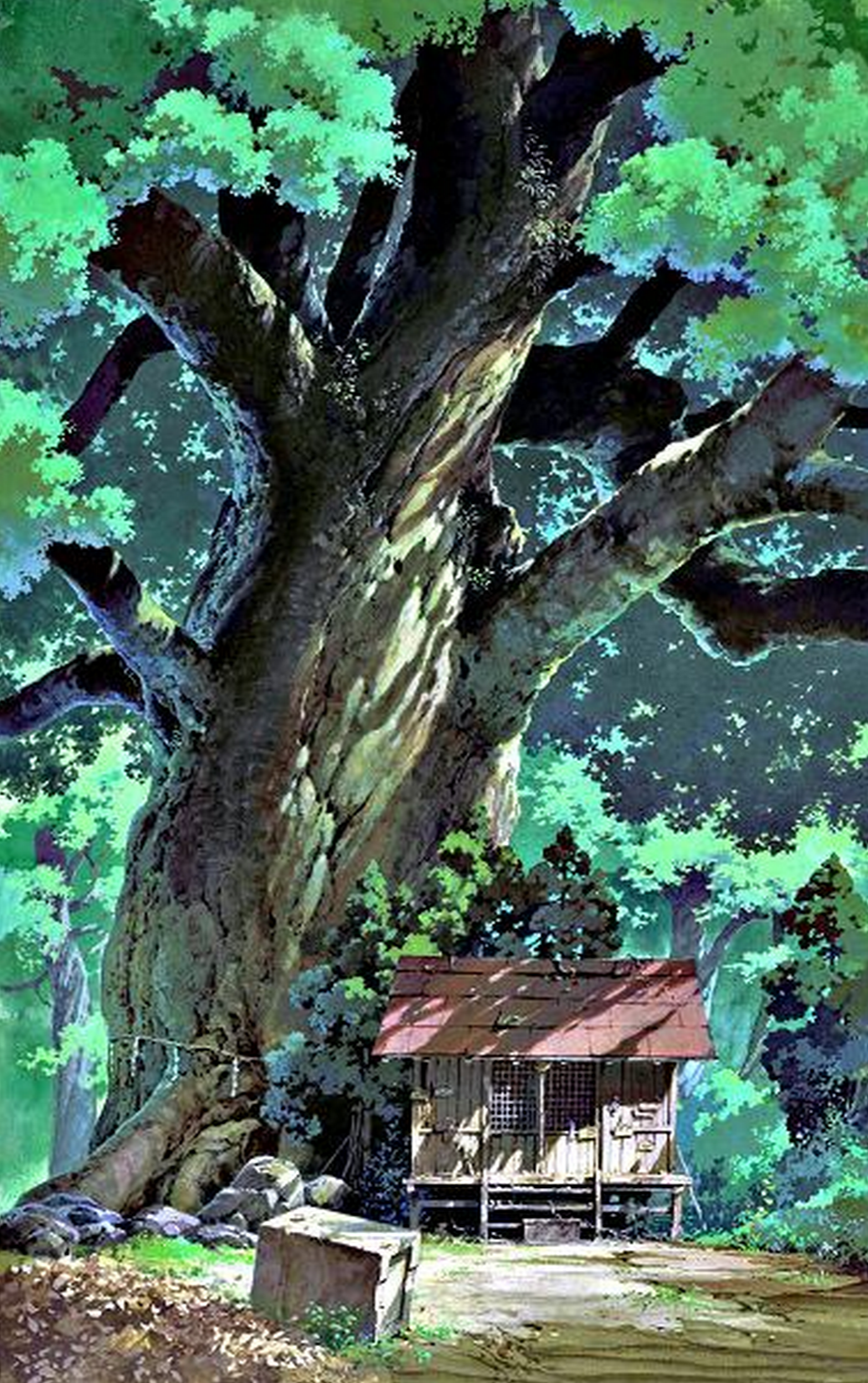
 If visiting Japan during May, the air will be filled with an aromatic smell that emanates from the camphor. Even within the cities one may notice the scent as these evergreen trees with brilliant foliage are often found in parks, on playgrounds or as shading trees along the streets.
The camphor trees can grow to monumental heights of about 30 meters and could have stems with incredible circumferences. Due to their longevity and sturdiness, they are also venerated as part of the SHINTO RELIGION (神道 ; the way of the gods) of Japan. In the vicinity of shrines, then sometimes very old specimen stand in all their venerability, housing a KAMI (神; gods, spirits, deities) that oversees the premises. A straw rope with white paper strips attached (注連縄・SHIMENAWA) around the lower stem indicates such a divine presence. I always liked the idea of a spirit inhabiting such places, it kind of makes the tree more approachable and gives it personality. In some venues there is also an information table put up to explain some facts and significance about the tree. While some of those specimen are surrounded by a wooden fence, others are allowed to be touched or hugged. For a moment one may unsnap from worldly being to enter into a spiritual connection with nature, allowing to find calm and harmony in oneself.
The Kusunoki (楠木; cinnamomum camphora), together with the GINKGO (銀杏; maidenhair tree), is my favorite tree. I can’t say exactly why this is, but I always kind of felt drawn to it. Personally, I really like the smell that gives me a languorous and cozy feeling because it connects me with many wonderful memories. For instance, my first trip to Japan in 2008, while extensively touring South Korea. After the initial travel visa expired, it was obvious to cross over to Japan to have it renewed. During that 3-day-stopover in early May, I visited KUMAMOTO CASTLE, which has a great number of camphor trees on its vast grounds. The scenery of the sublime castle, the grey, almost a bit forbidding, skies and then the smell of the Kusunoki, a symbiosis that created a profound impression. The tree vividly brings back scenes from the years living in Fukuoka as well, when cycling to and from school. In May its ubiquitous aroma, in the humid and hot summer periods, I especially appreciated the shade the tree lines spent along my commuting road or when going for a stroll in the parks.
Just a short article I would like to dedicate to this beautiful tree and to share the affection I hold for it.
You might also be interested in the following article(s)/page(s):
Article Guide:
For Japanese related words Hiragana (ひらがな), Katakana (カタカナ) and Kanji (漢字) are added for those interested in Japanese terminology.
Edition History:
- First published: May 15th, 2015
- Minor revisions & additions: August 20th, 2023
©MyLittle Dejima
 MyLittle Dejima
Hi! Thanks of the info! – I am interested in learning more about what spirit is believed to reside inside the camphor tree’s in Japan?
LikeLiked by 1 person
G’day William and thank you for your comment and question : ) Large trees like the camphor or any old trees are believed to be inhabited with spirits that look over the surrounding premises to assure flourishing and harmony of the eco-system that comprises of flora, fauna and humans alike as part of nature as a whole. It is my hope that my answer is satisfactory although I can’t tell you a specific name for the spirit of the camphor tree in particular, if that is what you are seeking for. For certain things can’t be named because it could be only a verbal concept of our human minds trying to describe something that we can just feel indescribably. Maybe a protective natural spirit, essence or force that inhales the breath of life to all things such as plants and animals is more accessible. Thanks for your exchange and hopefully until another time : ) Stay well and keep your spirits up !
LikeLike